United Kingdom
August 1, 2025
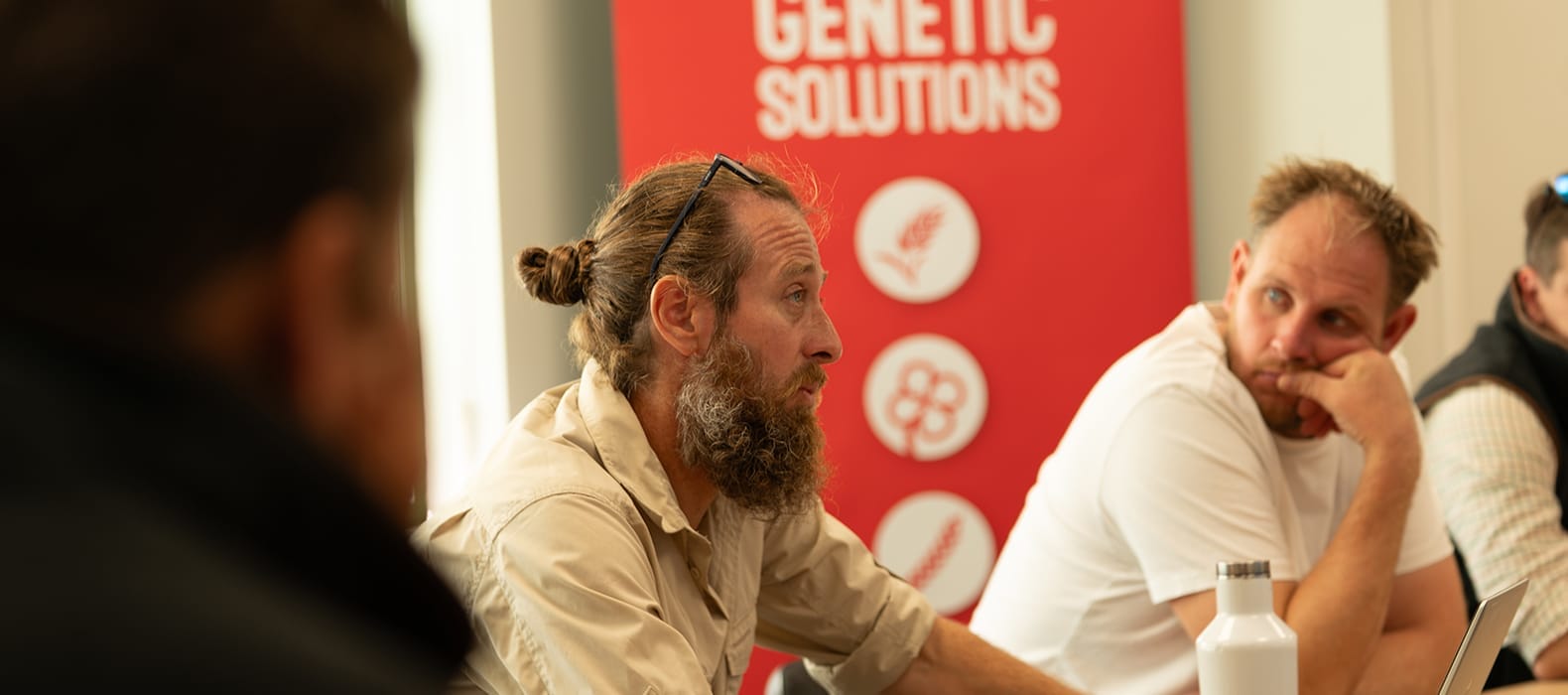
With our climate changing, disease pathogens evolving and the chemical armoury shrinking, the goalposts for breeding new wheat varieties are constantly shifting. To see how one breeder is rising to these challenges, four leading growers put their questions to Limagrain Field Seeds senior wheat breeder, Phil Tailby.
How can modern breeding techniques help meet future challenges?
Technology such as Marker Assisted Selection (MAS) and Genomic Selection has been around for several years, but is now delivering significant benefits to the varieties coming through, says Mr Tailby.

Limagrain Wheat Breeder Phil Tailby on breeding new wheat varieties
“MAS gives us the ability to select individuals with the specific genes that farmers want, such as Septoria or yellow rust resistance, very early in the breeding cycle, and do so far more intensively and efficiently than in the past.
“Genomic selection also allows us to model the more complex quantitative traits, such as yield, that come from multiple genes interacting with each other and the environment.
“Over the past 15 years, we have genotyped material to check for 20,000-30,000 markers to build a genetic profile of each potential variety.
In addition, everything is measured in the field (phenotyped), from height, yield, lodging, spec weight, Hagberg, etc. We can then use statistical models to predict how crosses will perform in the field, based on a vast amount of actual data that is constantly being updated.”
How are you tackling changing pathogens, such as yellow rust?
The evolution of yellow rust in recent years poses challenges for all breeders, and means new varieties need multiple ‘stacked’ resistance genes, to be more resilient, says Mr Tailby.
“We have the technology to map resistances, so we can identify those that work, and select the lines with the genes we want to use in combination together within any new variety. If you have the genetic marker, there’s a very high probability of having that gene as well.
“We can do this for any traits we have markers for, whether that’s yellow rust, brown rust, Septoria, or anything else.”
When people say a variety ‘breaks down’, is it the gene or the disease that’s changing?
“Pathogens change, genes don’t,” explains Mr Tailby.
“Resistance genes generally work by recognising the pathogen, then deploying a resistance mechanism of some sort. A hypersensitive response, for example, means when a spore lands on a plant, the plant recognises it, then kills the tissue around the spore to stop it spreading.

“As a pathogen replicates, it makes copies of its RNA/DNA, but it’s never a perfect system; there are always some errors. If, by chance, one of those errors happens to be in the genes that make up the sequence that codes for the protein the plant recognises, plants may no longer recognise the pathogen.”
As a breeder, what do you think about blending varieties?
Mr Tailby recognises there can be benefits to variety blends in some situations on farm, providing varieties are chosen carefully and end-user acceptance is there.
“Every variety will have a weakness of some sort, whether that’s blindingly obvious (e.g. straw strength or disease resistance), or less obvious, such as a particular weakness to a subtle abiotic stress.
By growing a blend, you are effectively ‘diluting’ the risk of any one variety having a poor year.
A variety with lower resistance to Septoria, for example, may do better in a blend with more resistant varieties, because there is less inoculum around.”
To learn more about our wheat varieties, click here
LG Legends
In a world of shifting climates, evolving disease pressures, and a shrinking chemical toolbox, breeding new wheat varieties has never been more complex, or more critical. Through open dialogue with experienced growers, Limagrain are ensuring that breeding innovation remains grounded in the realities of modern farming. As this Q&A shows, collaboration between breeders and farmers is key to developing resilient, high-performing varieties that are fit for the future.

This Q&A is taken from a Limagrain Field Seeds discussion with four ‘LG Legends’ growers; Ryan McCormack, Farm Manager at Dennington Hall Farms in Suffolk, Luke Palmer, of F.C Palmer & Sons near Cambridge, Rob Atkin of Atkin Farms in Staffordshire, and Cambridgeshire/ Bedfordshire contractor, Matt Redman.




 Topics
 Species