Raleigh, North Carolina, USA
March 5, 2026
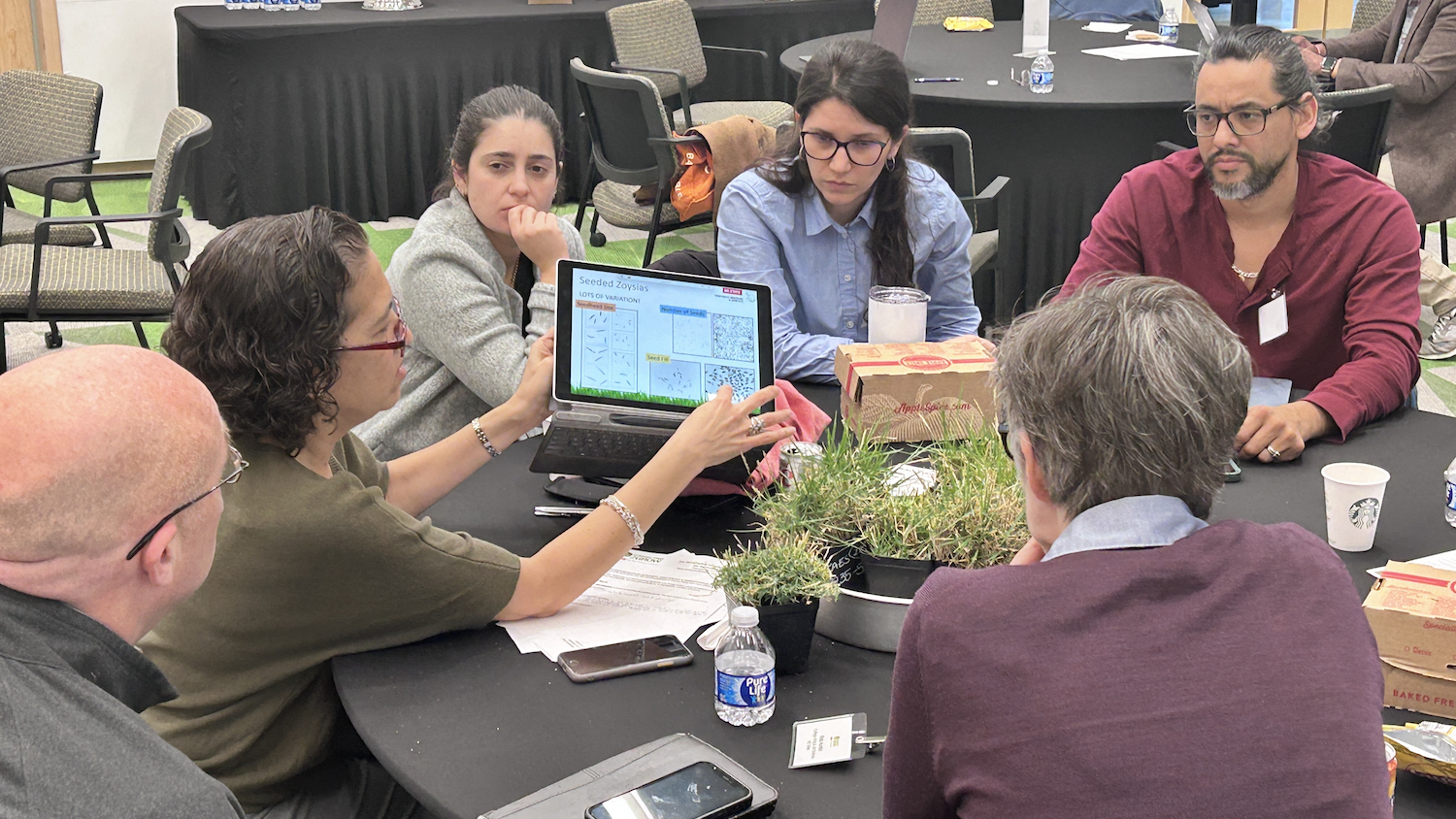 Scientists and engineers from NC State and other universities took part in the workshop. Here, Susana Milla-Lewis (holding up a computer) shares challenges she faces as a turfgrass breeder.
The N.C. Plant Sciences Initiative held its latest Connecting2Grow workshop on Feb. 26, bringing together dozens of researchers from plant breeding, engineering, physics and other disciplines at North Carolina State University and beyond.
The goal was to spark research ideas and spark collaborations for bringing sensor research to bear on the challenges of breeding plants with superior traits.
Mike Kudenov, an expert in optical sensor engineering with NC State University’s Department of Electrical and Computer Engineering, led the workshop with Susana Milla-Lewis, who leads the Turfgrass Breeding Program in the Department of Crop and Soil Sciences. Lauren Maynard, the N.C. PSI’s interdisciplinary project launch director, organized the event.
NC State Plant breeding researchers Simon Fraher (sweetpotato), Nonoy Bandillo (wheat), Hudson Ashrafi (blueberry) and Milla-Lewis, along with U.S. Department of Agriculture Agricultural Research Service’s Ben Fallen (soybean) discussed pressing challenges with the crops.
We would like tools that help us better see differences among our genotypes so that we can make better selections – and make those selections faster – to increase genetic gains.
The researchers noted that the need for manual, subjective, time-consuming and often destructive methods for evaluating thousands of plants in their breeding trials slows the breeding process.
As Milla-Lewis said, “We would like tools that help us better see differences among our genotypes so that we can make better selections – and make those selections faster – to increase genetic gains. Ultimately, that means developing cultivars that will be grown on farms and sold to our consumers in the state faster and more efficiently.”

Following the breeders’ presentations, technology experts showcased advanced imaging and sensing technologies, some originating from the biomedical field, that could serve as solutions:
- Khanh Kieu, of the University of Arizona’s Wyant College of Optical Sciences, discussed multiphoton microscopy.
- Vasily Astratov, of the University of North Carolina Charlotte, highlighted portable super-resolution cellphone-based microscopy.
- Rosario Porras-Aguilar, also of UNC Charlotte, focused on multifunctional microscopy for label-free and quantitative bioimaging.
- Wesley Legant, of the Lampe Joint Department of Biomedical Engineering at NC State and UNC Chapel Hill, described light sheet microscopy and single molecule imaging.
- Jing Zhang, of NC State’s Department of Horticultural Science, discussed RGB, multispectral and hyperspectral spectroscopy.
Workshop participants then worked in interdisciplinary groups to begin forming ideas for research projects to address the breeders’ challenges. Their ideas involved:
- a sensor-fusion package combining microwave, radio wave and acoustic imaging with generative artificial intelligence to solve the problem of below-ground phenotyping for root crops.
- radio frequency and ultrasonic probes to create a non-destructive method for assessing peanut pod maturity, a key to determining the best time to harvest
- a high-throughput method for measuring blueberry skin thickness, a proxy for firmness, using cell-phone-based microscopy and portable near-infrared devices
- an integrated system of microscopy, spectroscopy and imaging to assess early-season cotton challenges such as seedling vigor and stress
- an advanced multi-wavelength, multi-perspective imaging system to help turfgrass breeding programs count seed heads while simultaneously assessing their maturity
 Kara Peters, of NC State’s Department of Mechanical and Aerospace Engineering, presented her group’s ides for using advanced imaging systems to count seed heads and assess seed maturity in turfgrass.
N.C. PSI Executive Director Adrian Percy said he was impressed by these early ideas and excited to see potential solutions begin to take shape.
“I am eager to see some of the teams that came together at the workshop move forward, develop research proposals, gain funding and end up down the road being instigators of significant impact in our agricultural system, either here in North Carolina or more broadly across the United States,” he said.




 Topics
 Species