Westminster, Colorado, USA
July 17, 2025
A new Weed Science Society of America research article shows weed-zapping technologies to be equally effective as herbicides and mechanical control methods
A recently published article in the journal Weed Science shows electric control technologies can eradicate weeds just as effectively as herbicides or mechanical methods, with minimal risks to the crop, soil or the environment, despite displaying a potentially higher fire hazard risk if dry crop residues are present.
“Here, we show for the first time that electric weed control in viticulture has comparable efficiency to that achieved by herbicides,” says Catherine Borger, Ph.D., Principal Research Scientist, Western Australia Department of Primary Industries and Regional Development, who specializes in weed science. “Electric weed control will be of particular importance for those where herbicide resistance is increasingly problematic and for organic growers.”
In the study, Borger and Miranda Slaven (Research Scientist) conducted spring trials in vineyards near Yallingup, Western Australia, during 2022 and 2023. The researchers used a tractor fitted with an Zasso™ XPower electric weed control machine that featured a rear-mounted XPower 36 kW power supply unit and an XPS applicator mounted on each side, with six electrode arrays per applicator.
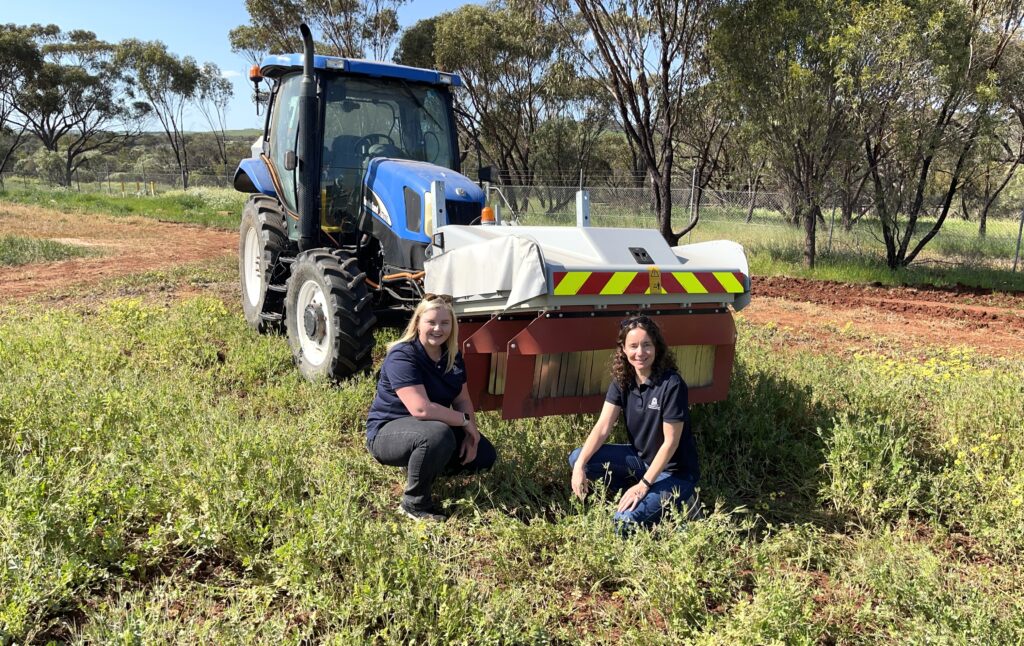 Miranda Slaven (left) and Catherine Borger (right) investigated electric weed control with a ZassoTM XPower machine.
“The scientific literature has not previously assessed electric weed control in comparison to other weed control techniques in spring vineyards, but our study showed that it provided weed control efficiency comparable to that of chemical and mechanical control tactics commonly used in these systems,” she says. “Further, there was no evidence of damage to the [grape] vines.”
Electric weed control technologies offer several important advantages compared to herbicide applications, points out Borger. “These advantages include no chemical residues in the environment or food, no rain-fast period after application, no restrictions on use in windy conditions due to drift, no chemical resistance and no off-target impacts on neighboring vegetation or waterways,” she says. “However, the disadvantages include slow application speed and high fuel usage.”
This research is the first to quantitatively assess fire risk from electric weed control. “It should be noted that in every field experiment we conducted during spring (September), there were zero fires, and this is the most common time of year for viticulture weed management in Western Australia,” emphasizes Borger. “Therefore, operation in winter or spring poses minimal fire risk. It is the recommendation of this study that electric weed control is suitable for use in winter/spring weed management within the mediterranean climate but not for control of summer or autumn weeds.”
More information about the study is available in the article: “Electric weed control—how does it compare to conventional weed control methods?. The research article is among other third-quarter 2025 research articles featured in Weed Science, a Weed Science Society of America journal, published online by Cambridge University Press. Borger can be contacted about the study at catherine.borger@dpird.wa.gov.au, or 0467 816 082.
About Weed Science
Weed Science is a journal of the Weed Science Society of America, a nonprofit scientific society focused on weeds and their impact on the environment. The publication presents peer-reviewed original research related to all aspects of weed science, including the biology, ecology, physiology, management and control of weeds. To learn more, visit www.wssa.net.




 Topics
 Species