Davis, California, USA
February 20, 2026
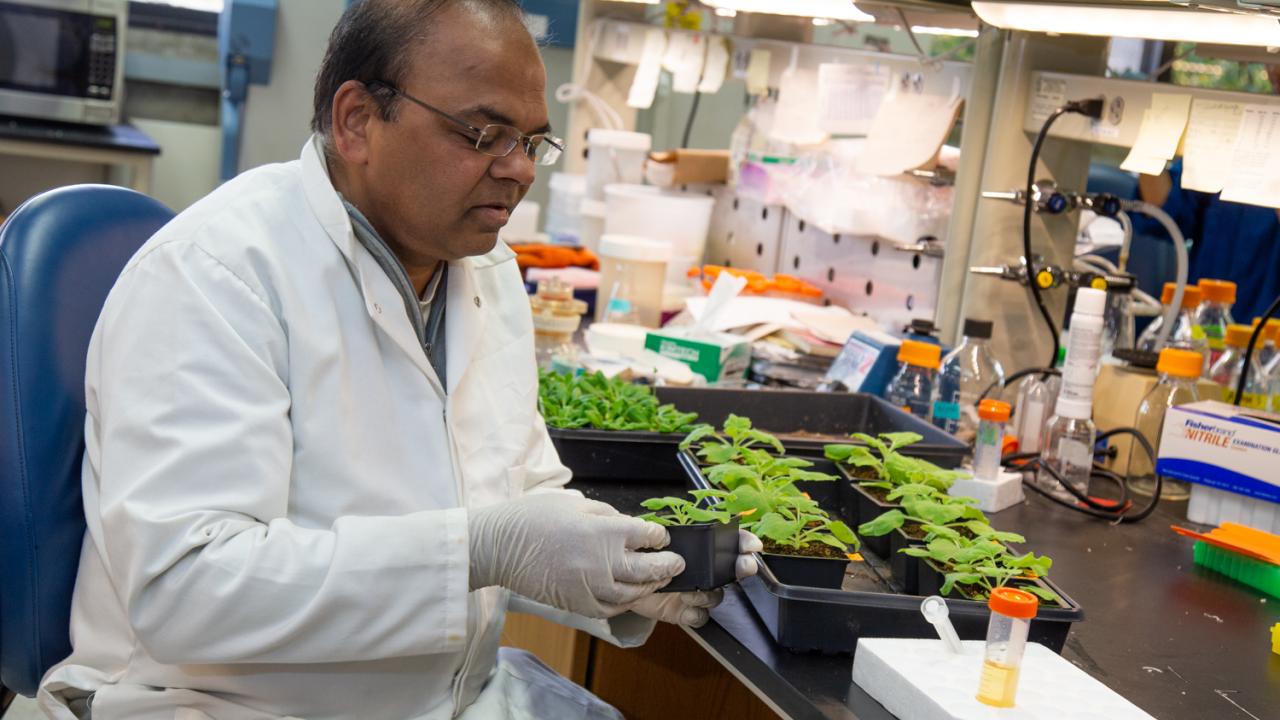
Gene editing with CRISPR/Cas9 is a powerful tool in medical sciences but it does not work well for plants, limiting the ability to use it to create new varieties. Researchers at UC Davis and the Innovative Genomics Institute have now developed an alternative, one-step method that opens up new ways to breed plants for better yields and pest resistance. Professor Savithramma Dinesh-Kumar, chair of the Department of Plant Biology, works with tobacco plants in his lab at UC Davis. (Sasha Bakhter / UC Davis)
Gene editing has enormous potential to help feed the world’s growing population, but it’s currently difficult, time-consuming, and only works in some plant species. A big part of the problem is CRISPR/Cas9’s size: it’s too large to be delivered into plant cells.
In a new study in Nature Plants, researchers from UC Davis and UC Berkeley’s Innovative Genomics Institute (IGI) show that a smaller alternative to CRISPR/Cas9 could help overcome these hurdles. They used an engineered version of a “jumping gene” enzyme to edit the genome of tobacco plants via a one-step process. The method was highly efficient, and the resulting gene edits were inherited by more than 90% of the next generation of plants—a heritability rate that matches that of Cas9.
“We need super-efficient gene editors to develop plants that can resist stressors such as drought and pathogens, or that produce higher yields,” said Savithramma Dinesh-Kumar, a professor and chair in the Department of Plant Biology. “This method has great potential for enabling the generation of plants with specific traits without requiring genetic modification.”
Read the full story from the College of Biological Sciences.
High-efficiency, transgene-free plant genome editing by viral delivery of an engineered TnpB (Nature Plants)




 Topics
 Species