Waupaca, Wisconsin, USA
March 10,2 026
Genetics don’t happen in a lab. They happen in the field.
But before a variety ever reaches a grower, it has to be developed somewhere. Selected under pressure. Tested across environments. Advanced deliberately.
That process is about to get better.
Legacy Seeds is building a new greenhouse — an investment in controlled environment research that will accelerate the pace of genetic development and strengthen the foundation behind every variety we advance.
This isn’t just a new building. It’s a commitment to what comes next.

The new greenhouse facility at Legacy Seeds’ Research & Learning Center in Waupaca, WI — built to accelerate genetic development and strengthen the foundation behind every variety we advance.
Why Controlled Environment Research Matters
In alfalfa breeding, time is one of the most limiting factors.
Every generation of selection requires a full growing season. Waiting on weather. Managing field variability. Working within the natural rhythms of plant development.
A greenhouse changes that equation.
Controlled environments allow breeding teams to:
Advance generations faster, reducing the time between selection and commercialization
- Evaluate parent material under consistent, repeatable conditions
- Screen for disease resistance and stress response with precision
- Protect early-generation material from environmental variables that can obscure true genetic potential
In field-based programs, a single bad weather year can set development back by a full season. In a greenhouse, the work continues.
At Legacy Seeds, faster development isn’t about cutting corners. It’s about compressing timelines without sacrificing the rigor that produces durable, trustworthy genetics. Our commitment to multi-year, multi-location validation doesn’t change. What changes is how efficiently we can build toward that validation.
Breeding with Purpose — Accelerated
Every breeding decision at Legacy Seeds starts with a question: what problem are we solving for the grower?
Winter survival. Disease tolerance. Stand persistence. Yield stability under pressure.
Those problems don’t wait. And the genetic solutions to them shouldn’t take longer than necessary to reach the field.
The new greenhouse will give Legacy’s breeding program the infrastructure to move with greater urgency — without trading away the discipline that defines how we advance genetics. Early-stage screening. Faster generation cycling. Tighter control over the conditions that reveal true genetic potential.
The goal isn’t speed for its own sake. The goal is getting better genetics into growers’ hands — sooner.
“
This greenhouse is a reflection of who we are as a company. Legacy Seeds has always been built on the idea that genetics are a long-term investment — for us and for the growers we serve. This facility gives us the tools to develop better genetics faster, while holding to the same standards of rigor and stewardship that define everything we do. It’s not just infrastructure. It’s a signal of what’s ahead.
— Colin Steen, CEO, Legacy Agripartners
Part of a Larger Investment
The greenhouse doesn’t stand alone.
It’s an extension of the Research & Learning Center in Waupaca, Wisconsin — and of a broader commitment to building the infrastructure that elite alfalfa genetics require.
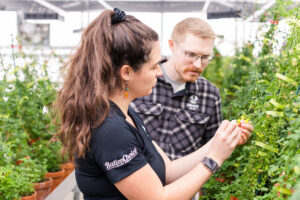
Hands-on evaluation at the plant level — where genetics decisions begin. The Legacy Seeds team at work in the greenhouse, assessing breeding material under controlled conditions.
Controlled environment research. Field trials across diverse environments. Rigorous multi-year advancement protocols.
Each piece reinforces the others. The greenhouse accelerates early-stage selection. The field validates performance across real production conditions. And the data generated across both environments informs every advancement decision.
Together, they represent a complete system — one designed not just to develop genetics, but to protect them.
At Legacy Seeds, infrastructure is never built for appearance. Every investment is grounded in one question: will this make the genetics better? The answer here is straightforward. A greenhouse gives our program tools we didn’t have before. That translates directly to stronger, more validated genetics for the branded partners and growers we serve.
What This Means for the Genetics Behind Your Fields
For growers, the most important outcome of any facility is what it produces.
Not the building itself. Not the announcement.
The genetics that emerge from it — and how they perform in the field, year after year.
The new greenhouse is a step toward more. More generations evaluated. More stress screening completed before a line moves forward. More confidence in the genetic foundation behind every product that reaches the marketplace.
Consistency isn’t accidental. Persistence doesn’t happen without intentional selection. And trustworthy genetics don’t develop without the infrastructure — and the investment — to support them.
That investment is underway.
The Bottom Line
Strong genetics require strong systems.
From selection environment to breeding objectives. From disease screening to multi-year trial validation. From seed production oversight to what lands in the drill.
Every step matters. Every system reflects a commitment — or a gap.
At Legacy Seeds, building a new greenhouse is a statement about what we believe: that better infrastructure produces better genetics, and that better genetics produce better outcomes in the field.
Because behind every bag of seed is a breeding program.
And behind that program is a responsibility to keep getting better.
To learn more about the genetics behind Legacy Seeds and what’s growing at our Research & Learning Center, visit LegacySeeds.com.




 Topics
 Species