29 April 2026
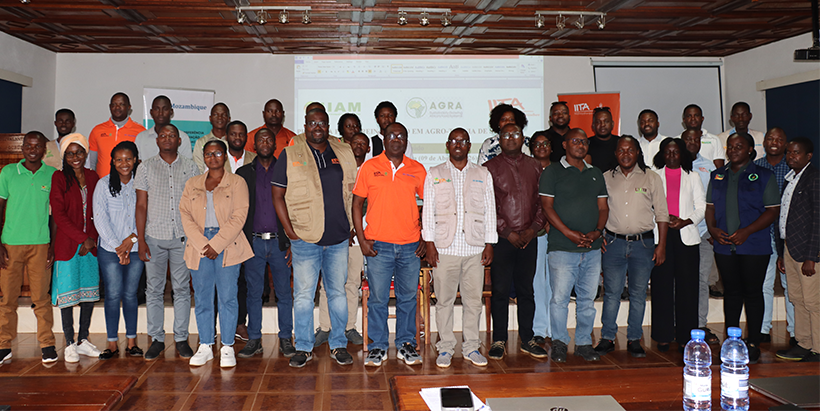 Participants of the training included researchers, seed multiplication companies, and seed quality verification technicians.
To expand information and improve the availability of quality seeds in Mozambique, IITA–CGIAR, the Agricultural Research Institute of Mozambique (IIAM), and the Alliance for a Green Revolution in Africa (AGRA) conducted training on soybean seed production and multiplication for technicians and Seed companies operating in Zambézia and Nampula provinces.
The two-day training, which took place in the district of Gurúè, Zambézia province, focused on soybean seed production, highlighting the five new varieties recently released by IITA and IIAM that offer improved productivity, better marketing, and increased consumption.
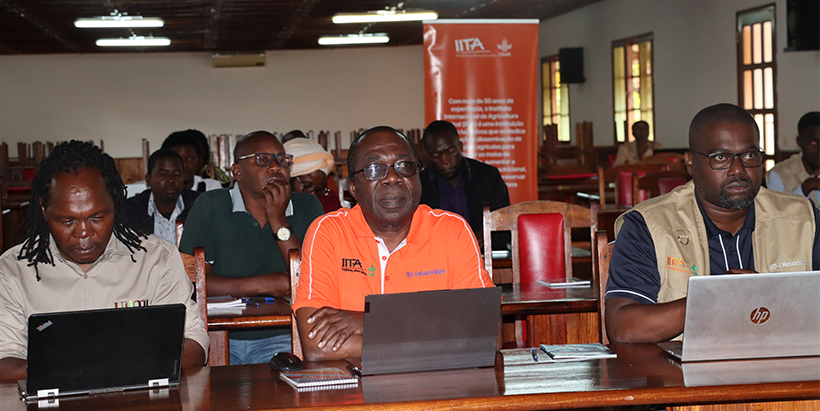 Participants during the training session.
“We have launched five new short-cycle, high-yielding, drought- and disease-resistant soybean varieties. So, the main reason for organizing this training is to allow technicians and seed producers to come and acquire knowledge about the new varieties,” explained Steve Boahen, the IITA representative in Mozambique.
“So, the first actors in the chain are the seed companies, and that is why they were here to learn all the characteristics that help distinguish one variety from another while still in the field. At the same time, we had inspectors and laboratory technicians who controlled seed quality, as the seed is the most important input in the production chain,” added Henriques Colial, representing IIAM.
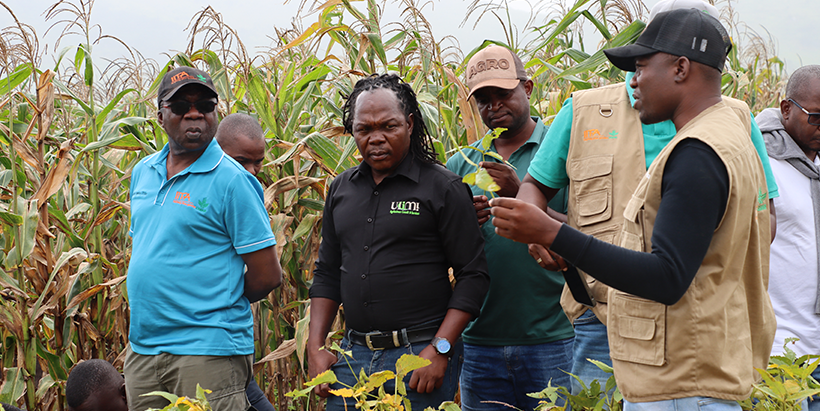 IITA Research assistant, Francisco Domingos, explaining the characteristic of one seed plant varieties.
Divided into two parts, the training began with a theoretical session that discussed the soybean production and marketing calendar, highlighting the importance of mastering and rigorously following the protocols to ensure quality production. The trainees were also shown methods for calculating yield in soybean seed production and its impact on the business’s sustainability, knowledge intended to be extended to farmers to help them better control the income generated. The discussion also extended to the characteristics of the new varieties, their yield level, resistance to diseases and pests, production techniques, quality control and seed certification, and gender equality and social inclusion in agriculture.
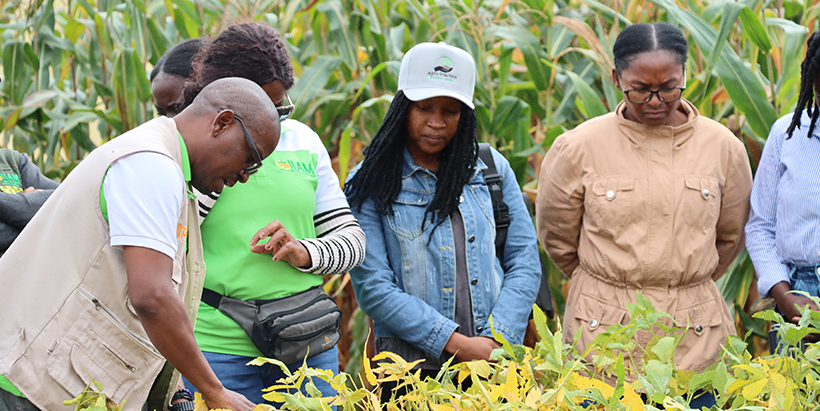 IIAM researcher, Henriques Colial, taking an on-field session during the training.
Following the training, a visit was made to the IITA soybean seed multiplication field to gain a more practical perspective, providing an opportunity to confirm classroom presentations, clarify doubts, and obtain additional information.
The trainees, in turn, stated that the knowledge gained will enable better guidance for farmers on soybean production through the establishment of demonstration fields for these new varieties, thus enabling them to better choose which varieties to adopt for improved productivity and profitability.
After the training, the companies will receive follow-up support, including the delivery of seed samples for testing in their production fields, selection of the varieties most adapted for multiplication, and delivery to the farmers, who are the end users. It is worth remembering that at the end of 2025, IITA and IIAM released 5 new soybean varieties to the Mozambican market, namely Malonda (TGx 2014-16MF), Ovilela (TGx 2002-35FM), Bela (TGx 2001-24FM), Ulimi (TGx 2014-2FM), and 10E (TGx 1835-10E), which are more productive and profitable. Currently, the two institutions are disseminating information and adopting strategies to expand access to these varieties.




 Topics
 Species