Westminster, Colorado, USA
July 14, 2026
A new Weed Science Society of America research article shows a generously seeded cereal rye cover crop helps reduce weed pressure for organic no-till soybean production

A Weed Science Society of America (WSSA) journal, Weed Science, recently published a research article showing that a cereal rye cover crop helps reduce weed pressure for organic no-till soybean production, particularly when seeded at higher rates. The two-year research study reviewed field experiments conducted during the 2021-2022 and 2022-2023 growing seasons near Rock Springs, Pennsylvania, at the Pennsylvania State University Russell E. Larson Agricultural Research Center.
“The aim of this study was to compare the magnitude of weed control and soybean yield under different cereal rye densities within the soybean phase of cover-crop based organic rotational no-till production,” states Laurel Wellman, a Ph.D. student in plant sciences at Pennsylvania State University, and the study’s corresponding author. “Our results indicated that all cereal rye seeding rates reduced weed biomass compared to the unseeded cereal rye control plots, and that the higher cereal rye seeding rates reduced weed biomass significantly more than the lower seeding rates.”
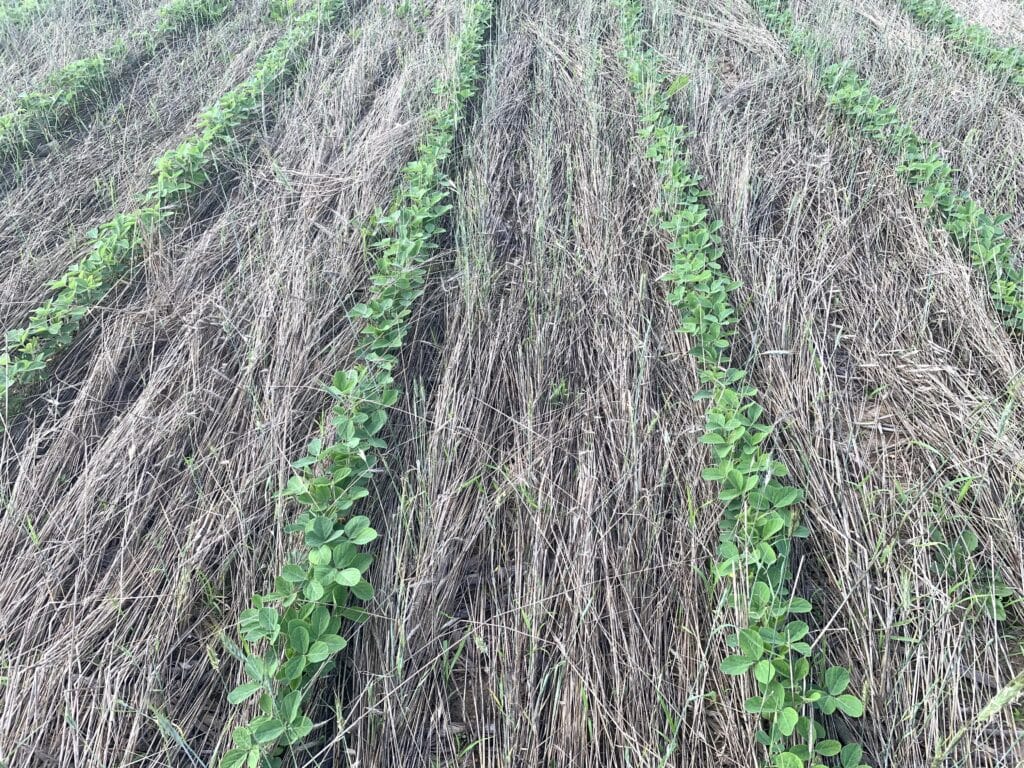 A newly published research paper from Penn State University shows high seeding rates improve weed suppression from roll-crimped cereal rye in organic no-till soybean fields.
In two experiments, the researchers evaluated rye cultural management strategies for rye biomass, weed suppression, and soybean yield. They tested:
- four rye seeding rates (0.5-3 bu. acre) and two sowing arrangements (grid vs. row sowing)
- fall-applied poultry litter (0, 1.5, 3 tons acre) with two soybean planting dates (planting green or standard planting).
“Increasing cereal rye seeding rate did not lead to increased rye biomass but did increase weed suppression,” points out Wellman. “Soybean yield was unaffected by rye seeding rates, and sowing arrangement did not affect any response.”
Interestingly, “while fall poultry litter significantly increased rye biomass, weed suppression was unaffected,” she adds.
During one of the two cropping seasons studied, planting green reduced soybean establishment and yield, note the researchers. However, they also state that “these results highlight the limitations of organic no-till soybean production within grain crop rotations in the Northeastern U.S. when using cereal rye as a stand-alone weed suppression method. Increasing cereal rye seeding rates or applying fall fertility could be effective cultural practices when integrated with other weed control tactics to supplement weed suppression by rye surface mulch.”
Overall, and perhaps most importantly, notes Wellman, the study “indicates that higher cereal rye seeding rates improved weed suppression independently of cereal rye biomass.”
More information about the study is available online in the article: “Cultural management of cereal rye for weed suppression in cover crop-based organic rotational no-till soybean.” The research article is among others recently featured in Weed Science, a Weed Science Society of America journal, published by Cambridge University Press. Wellman can be contacted about the study at lew5444@psu.edu.
About Weed Science
Weed Science is a journal of the Weed Science Society of America, a nonprofit scientific society focused on weeds and their impact on the environment. The publication presents peer-reviewed, original research related to all aspects of weed science, including the biology, ecology, physiology, management and control of weeds. To learn more, visit www.wssa.net.




 Topics
 Species