Germany
October 6, 2026
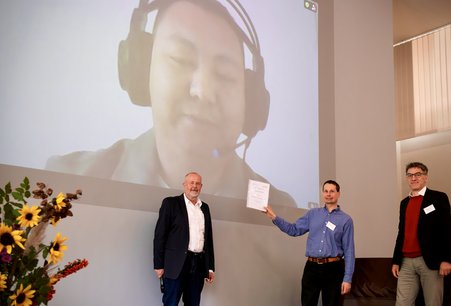
Due to travel commitments, the prize winner, Dr Yu Guo, joined the event online. Pictured from left to right are: Prof. Dr Andreas Houben (Managing Director of the Association for the Promotion of Crop Research), Dr Martin Mascher (Head of the Domestication Genetics Research Group) and Prof. Dr Jochen Reif (Head of the Breeding Research Department at the IPK and laudator).
How did wild barley become one of humanity’s oldest cultivated plants? Dr Yu Guo has used genetic evidence to trace this history. On 6 October 2026, he was awarded the Gatersleben Research Prize for his outstanding doctoral thesis as part of the IPK’s Institute Days. The Gatersleben Association for the Promotion of Crop Research (Gemeinschaft zur Förderung der Kulturpflanzenforschung Gatersleben e. V.) awards the € 2,500 prize, supported by the Salzlandsparkasse and the IPK.
Dr Guo completed his thesis in the ‘Domestication Genomics’ research group, led by Dr Martin Mascher. He published the results in 2025 as the first author in the journal Nature. For his research, he analysed the genomes of almost 700 wild and cultivated barley samples from gene bank collections, as well as 23 archaeological samples. By tracing individual sections of the genome back to their wild ancestors, he reconstructed the origins of cultivated barley in both space and time. The results indicate that the barley genome resembles a mosaic, with contributions from various wild barley populations. The study also suggests that a common ancestral population of cultivated barley emerged during an extended period of early cultivation in the Fertile Crescent. Subsequently, further genetic exchange with wild barley, along with regional developments, shaped its diversity. This work significantly advances our understanding of crop plant evolution. At the same time, it paves the way for the more effective utilisation of the genetic diversity preserved in gene banks for plant breeding.
In his laudatory speech, Prof. Dr Jochen Reif, Head of the Department of Breeding Research at the IPK, commended the innovative research approach and clear presentation of the results. A total of 14 research works were submitted. The selection process involved international peer review and was conducted in two stages. Dr Yu Guo attended the event online and presented his research.
Von der Wildpflanze zur Kulturgerste - Yu Guo erhält Gaterslebener Forschungspreis 2026
Wie wurde Wildgerste zu einer der ältesten Kulturpflanzen der Menschheit? Dr. Yu Guo hat diese Geschichte anhand genetischer Spuren nachgezeichnet. Für seine herausragende Doktorarbeit wurde er am 6. Oktober 2026 im Rahmen der Institutstage des IPK mit dem Gatersleben-Forschungspreis ausgezeichnet. Die mit 2.500 Euro dotierte Auszeichnung wird von der Gemeinschaft zur Förderung der Kulturpflanzenforschung Gatersleben e. V. mit Unterstützung der Salzlandsparkasse und des IPK vergeben
Yu Guo fertigte seine Dissertation in der Forschungsgruppe „Domestikationsgenomik” unter der Leitung von Dr. Martin Mascher an. Die Ergebnisse veröffentlichte er 2025 als Erstautor in der Fachzeitschrift Nature. Für seine Forschung untersuchte er die Genome von annähernd 700 Wild- und Kulturgersten aus Genbank-Sammlungen sowie von 23 archäologischen Proben. Indem er einzelne Abschnitte des Erbguts bis zu ihren wilden Vorfahren zurückverfolgte, konnte er die Entstehung der Kulturgerste räumlich und zeitlich rekonstruieren. Die Ergebnisse zeigen, dass das Erbgut der Gerste einem Mosaik gleicht, zu dem verschiedene Wildgerstenpopulationen beigetragen haben. Die Studie legt zudem nahe, dass eine gemeinsame Ausgangspopulation der Kulturgerste während einer langen Phase des frühen Anbaus im Fruchtbaren Halbmond entstand. Später prägten weiterer genetischer Austausch mit Wildgersten sowie regionale Entwicklungen ihre Vielfalt. Die Arbeit trägt wesentlich zum Verständnis der Evolution von Kulturpflanzen bei. Zugleich schafft sie eine Grundlage, um die in Genbanken bewahrte genetische Vielfalt gezielter für die Pflanzenzüchtung zu erschließen.
In seiner Laudatio würdigte Prof. Dr. Jochen Reif, Leiter der Abteilung Züchtungsforschung am IPK, den innovativen Forschungsansatz und die klare Darstellung der Ergebnisse. Insgesamt waren 14 Arbeiten eingereicht worden. Die Auswahl erfolgte in einem zweistufigen Verfahren mit internationaler Begutachtung. Guo nahm digital an der Veranstaltung teil und stellte seine Forschung vor.




 Topics
 Species