July 2013
Source: SeedInfo 45, Official Newsletter of the WANA Seed Network
A well-functioning formal seed system is comprised of key components along the seed value chain within the agricultural research for development continuum. However, national seed systems in developing countries are characterized by ineffective policy and regulatory frameworks, inefficient institutional and organizational arrangements, deficiencies in infrastructure, limited resource allocation, limited trained and motivated human resources, etc. These inherent weaknesses are limiting farmers’ access to quality seed of many crops. Management of the variety release system, arrangements for early generation seed production (breeder, basic), and seed certification schemes remain major constraints to national seed program development. For example in the CWANA region, very few countries have independent variety release mechanisms, seed certification schemes, and well organized early generation seed production. The establishment of an effective, transparent, and independent national variety release mechanism will enhance the flow of new varieties from research institutions. A seed certification scheme will ensure the supply of quality seed from NARS to seed companies and, eventually, to farmers. The result will be increased production and productivity, food security, and better incomes for farmers. In this regard, the role of trained and skilled human resources in leading and managing the seed sector is crucial.
Regional Course on Variety Identification, Maintenance, Quality Seed Production, and Certification, Cairo, Egypt
Variety description for registration and release, variety maintenance for quality seed production, and seed certification for quality assurance are specialized tasks where technical capacity and managerial expertise are required at the national level. This course was designed to improve the national capacity to conduct value for cultivation and use (VCU), to determine agronomic performance, and establish the distinctness, uniformity, and stability (DUS) required for variety registration for release.
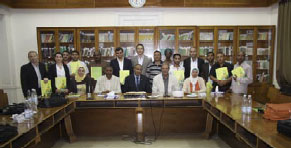
Participants of regional seed course, Cairo, Egypt
Course organization
The course was organized from 21 April to 2 May 2013 in close collaboration with the Central Administration for Seed Certification (CASC). Apart from CASC, agricultural research centers
(ARCs) and the Central Administration for Seed Production (CASP) and its staff also participated in the course as resource persons for the lectures; and they arranged the practical sessions and field visits.
Course program
The course program blended theoretical lectures with practical sessions and field visits relevant to variety description and maintenance as well as quality seed production and certification.
Theoretical lectures delivered first hand were followed by presentations by national resource persons to contextualize their application in a national setting, taking into account the Egyptian seed system. The lectures were followed by handson practical sessions and visits to fields and/or laboratories. These activities provided the attendees with a better understanding of the lectures, helped them acquire the necessary skills in the subject, and placed the application in a national setting.
Apart from ICARDA, CASC, ARC, and CASP staff, the resource persons included staff from the Agricultural and Genetic Engineering Research Institute (AGERI) and the National Genebank of Egypt. Resource persons from these institutions delivered theoretical lectures, guided the discussions, and accompanied participants for the hands-on practical training. Field visits were made to ARC (for variety development, variety maintenance, and foundation seed production), to CASP (for seed production, processing, and storage), to CASC (for DUS trails, field inspection, control plots, and laboratory seed testing), and to AGERI (for biotechnology laboratory) facilities in Giza and Kafir El-Sheikh. Participants of the course also made presentations on the status of the national seed industry in their countries and shared their experiences with their fellow participants. The participants were tasked to prepare proposals addressing the constraints identified in a SWOT analysis of their national seed programs, their present responsibilities, and the anticipated developments of the national seed sector. The purpose of the exercise was to enable the participants to identify gaps and prepare a proposal based on the knowledge acquired through the lectures, practical sessions, field visits, and country reports presented during the course. The proposals were expected to enable the participants to translate the theory into practice and prepare projects to address the issue at the national level.
Course participants
The course participants were the technical staff involved in variety evaluation and maintenance from NARS and seed production and certification officers from national seed programs. A total of 15 participants from 10 countries – Algeria (1), Egypt (2), Ethiopia (3), Jordan (1), Lebanon (1), Palestine (1), Sudan (1), Syria (2), Tunisia (1) and Yemen (2) – participated in the course. Of the participants, three (20%) were women who are involved in the key components of their national seed system – plant breeding, variety maintenance, and seed production.The Arab Fund for Social and Economic Development funded 12 participants from national agricultural research and seed programs in Arab countries. The USAID seed project supported three participants from Ethiopia.
by Zewdie Bishaw, ICARDA-Ethiopia, P.O. Box 5689, Addis Ababa, Ethiopia; E-mail: z.bishaw@cgiar.org
In-country Course on Variety Identification and Maintenance, Erbil, Kurdistan Regional Government (KRG), Iraq
The Japanese International Cooperation Agency is implementing a project on Wheat Productivity Improvement Towards Food Self-sufficiency in collaboration with the Ministry of Agriculture and Water Resources, KRG, Iraq. ICARDA is providing technical support. It is strengthening the human resources and providing training in seed science and technology as one of the components of the human resources development program. The project covers a wide range of courses in seed science and technology.
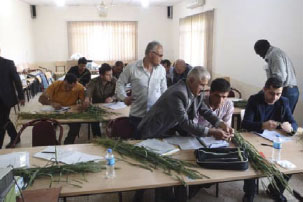
Participants of in-country seed course, Erbil, KRG, Iraq
Course organization
The course was organized from 21-26 April 2013 in close cooperation with the Seed Department and Agricultural Research Department of the Ministry of Agriculture and Water Resources, KRG, Iraq.
Course program
Variety identification is essential for variety release, to maintain the varietal identity during seed production and certification, and in grain production, trading, processing, and endproduct
consumption. The course provided the technical know-how on DUS testing and its implications for variety release, registration, maintenance, foundation seed production, and certification. The course program consisted of classroom lectures and practical sessions on DUS testing and variety maintenance.
Course participants
Twelve participants from all the provinces of KRG, Iraq attended the course. They were mostly plant breeders and field inspectors involved in quality seed production and certification
by Abdoul Aziz Niane, ICARDA, P.O. Box 114/5055, Beirut, Lebanon; E-mail: a.niane@cgiar.org




 Topics
 Species