Cold Spring Harbor, New York, USA
March 12, 2026
CSHL Professor & HHMI Investigator Zachary Lippman and colleagues have identified more than 2.3 million conserved non-coding sequences across 314 genomes from 284 plant species—some more than 400 million years old. Their research provides an invaluable tool for plant breeders and a new understanding of plant evolution.
 CSHL Professor & HHMI Investigator Zachary Lippman says that botanical gardens and herbarium greenhouses like this one at Mount Holyoke College are crucial for the preservation of wild plant species. Image: Zachary Lippman
You’ve heard of deep space, but what about deep time? Today’s geneticists and evolutionary biologists can extend their investigations further back in time than ever imagined. Still, many mysteries remain. One has vexed biologists for decades. In both plants and animals, gene sequences and functions are often conserved across species over hundreds of millions of years. However, this breaks down when comparing DNA that controls gene activity. And no one has been able to pin down whether this “regulatory DNA” is conserved in plants at all. It got to the point where many thought such conservation simply does not exist. Think again.
A new study published in Science by Cold Spring Harbor Laboratory (CSHL) and international collaborators reveals the discovery of more than 2.3 million regulatory DNA sequences conserved across 314 plant genomes from 284 species. These “conserved non-coding sequences” (CNSs) were identified using a new computational tool called Conservatory, developed between the labs of Idan Efroni at Hebrew University, Madelaine Bartlett at Sainsbury Laboratory Cambridge University, and Zachary Lippman at CSHL. Amazingly, the team found that some of these CNSs date back to before flowering plants split from their non-flowering ancestors over 400 million years ago.
Talk about deep time! How did their approach yield such a bounty of discovery?
The key was to examine and compare the order and makeup of all gene groups on a tiny scale, from one ancestor to the next, across hundreds of genomes. CSHL postdoc Anat Hendelman, a co-first author of the study, was amazed to see how many of the CNSs they found have been around all along. “Picking apart and genetically editing these CNSs confirmed they’re essential for developmental function,” Hendelman says.
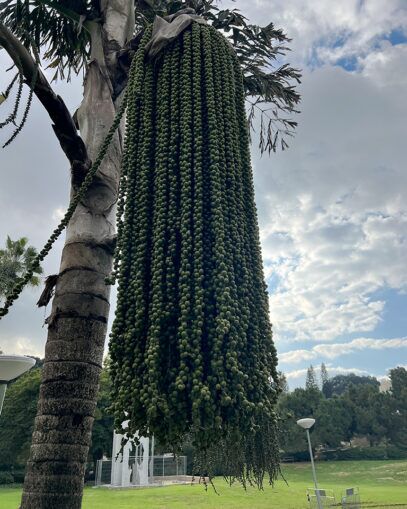
Fishtail palm, seen here at the Weizmann Institute in Israel, is native to Southeast Asia. Today, it also grows in parts of Africa, Latin America, and southern Florida. Image: Zachary Lippman
The team’s research revealed three core principles of CNS evolution in plants. First, though the spacing of these sequences varies, the order in which they appear on the chromosome is conserved. Second, when genomes get rearranged, CNSs start associating with different genes. Finally, ancient CNSs tend to persist when genes become duplicated, a crucial feature of plant genome and gene family evolution.
“This was actually one reason CNSs could not be discovered using the same approaches used in animals,” Lippman explains. “We didn’t just find CNSs using this innovative approach. We found that new regulatory sequences often come from old CNSs that were modified after gene duplication. This helps explain how novel regulatory elements emerge.”
With the Conservatory project, plant biologists like CSHL project collaborator David Jackson can now access what the researchers call a “comprehensive atlas of regulatory conservation across plants, including dozens of crop species and their wild ancestors.”
That’s a huge resource for plant breeders looking to meet major challenges, such as droughts and food scarcity. But the implications go far beyond agriculture. As Lippman puts it, “It’s a new lens on the evolution of life across eons and will make genome editing far more efficient for engineering crop traits.”
Funding
Binational Science Foundation, Israeli Science Foundation, Howard Hughes Medical Institute, National Science Foundation Plant Genome Research Program, USDA National Institute of Food and Agriculture, Gatsby Foundation
Citation
Amundson, K.R., Hendelman, A., et al., “A deep-time landscape of plant cis-regulatory sequence evolution”, Science, March 12, 2026. DOI: 10.1126/science.adt8983




 Topics
 Species